
L a N e t

Loading

Nigeria's free digital learning hub. Videos, lecture notes, practice questions and leaderboards aligned with CCMAS, NBTE, NCCE, WAEC, NECO, IJMB and JAMB curricula.

  • 100% Free — No Subscription. No Paywall. Ever.

PHY 102 — GENERAL PHYSICS 2

Physics · 100 Level · Second Semester

About this course

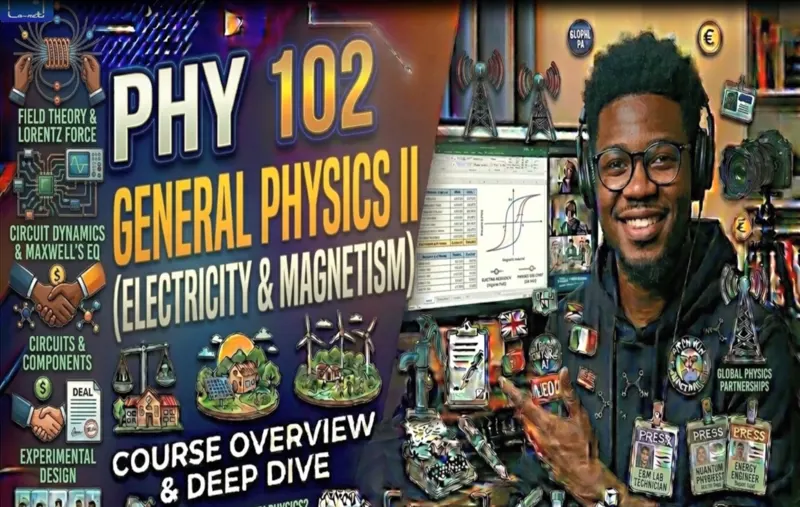
PHY 102 GENERAL PHYSICS 2 is a 100 Level course in the Physics department, taught in the Second Semester. On La-Net Hub you can watch all 33 recorded lectures for free, grouped into 11 series, read the course lecture note online or download it as a PDF, and test yourself with practice questions.

Capacitance, conductors, and DC circuits are closely related concepts in electricity. Capacitance refers to the ability of a system, usually a capacitor, to store electric charge and energy in an electric field between two conductors separated by an insulator. Conductors are materials, like metals, that allow electric charges to move freely due to their abundance of free electrons, making them essential for carrying current. In DC circuits, where current flows steadily in one direction, conductors form the pathways for electrons, while capacitors can regulate voltage, store energy, or filter signals. Together, these elements explain how electric charge is stored, transferred, and controlled in practical systems ranging from simple batteries to complex electronic devices.

Electromagnetic induction is the process by which a changing magnetic field produces an electric current in a conductor, a principle discovered by Michael Faraday. This phenomenon is the foundation of how generators produce electricity and how transformers work to adjust voltage levels in power systems. A transformer uses two coils of wire, called the primary and secondary windings, wrapped around a magnetic core; when alternating current flows through the primary coil, it creates a varying magnetic field that induces a voltage in the secondary coil. Depending on the ratio of turns in each coil, transformers can either step up or step down voltage, making them essential for efficient power transmission across long distances. Together, electromagnetic induction and transformers explain how electrical energy is generated, transferred, and distributed in modern technology.
Lectures in this course

Series 1: Capacitance, Conductors, and DC Circuits (SERIES 2) · Part 1

  1. Capacitance, Conductors, and DC Circuits 1 11 minutes 57 seconds
  2. Capacitance, Conductors, and DC Circuits 2 10 minutes 51 seconds
  3. Capacitance, Conductors, and DC Circuits 3 10 minutes 2 seconds

Series 2: Capacitance, Conductors, and DC Circuits (SERIES 2) · Part 2

  1. Capacitance, Conductors, and DC Circuits 1 11 minutes 10 seconds
  2. Capacitance, Conductors, and DC Circuits 2 10 minutes 1 second
  3. Capacitance, Conductors, and DC Circuits 3 9 minutes 14 seconds

Series 3: Electromagnetic Induction and Transformers (SERIES 4) · Part 1

  1. Electromagnetic Induction and Transformers 1 7 minutes 14 seconds
  2. Electromagnetic Induction and Transformers 2 7 minutes 21 seconds
  3. Electromagnetic Induction and Transformers 3 6 minutes 58 seconds

Series 4: Electromagnetic Induction and Transformers (SERIES 4) · Part 2

  1. Electromagnetic Induction and Transformers 1 6 minutes 41 seconds
  2. Electromagnetic Induction and Transformers 2 6 minutes 46 seconds
  3. Electromagnetic Induction and Transformers 3 6 minutes 26 seconds

Series 5: Electrostatics and Electric Fields (SERIES 1) · Part 1

  1. Electrostatics and Electric Fields 1 8 minutes 43 seconds
  2. Electrostatics and Electric Fields 2 8 minutes 12 seconds
  3. Electrostatics and Electric Fields 3 8 minutes 36 seconds

Series 6: Electrostatics and Electric Fields (SERIES 1) · Part 2

  1. Electrostatics and Electric Fields 1 8 minutes 3 seconds
  2. Electrostatics and Electric Fields 2 7 minutes 35 seconds
  3. Electrostatics and Electric Fields 3 7 minutes 56 seconds

Series 7: Magnetism and Magnetic Properties (SERIES 3) · Part 1

  1. Magnetism and Magnetic Properties 1 8 minutes 24 seconds
  2. Magnetism and Magnetic Properties 2 7 minutes 50 seconds
  3. Magnetism and Magnetic Properties 3 8 minutes 39 seconds

Series 8: Magnetism and Magnetic Properties (SERIES 3) · Part 2

  1. Magnetism and Magnetic Properties 1 7 minutes 44 seconds
  2. Magnetism and Magnetic Properties 2 7 minutes 14 seconds
  3. Magnetism and Magnetic Properties 3 8 minutes 1 second

Series 9: Maxwell's Equations, Oscillations, and AC Circuits (SERIES 5) · Part 1

  1. Maxwell's Equations, Oscillations, and AC Circuits 1 9 minutes 44 seconds
  2. Maxwell's Equations, Oscillations, and AC Circuits 2 10 minutes 19 seconds
  3. Maxwell's Equations, Oscillations, and AC Circuits 3 10 minutes 18 seconds

Series 10: Maxwell's Equations, Oscillations, and AC Circuits (SERIES 5) · Part 2

  1. Maxwell's Equations, Oscillations, and AC Circuits 1 8 minutes 58 seconds
  2. Maxwell's Equations, Oscillations, and AC Circuits 2 9 minutes 31 seconds
  3. Maxwell's Equations, Oscillations, and AC Circuits 3 9 minutes 34 seconds

Series 11: Resonance, Damping, and Coupled Vibrations (SERIES 2)

  1. Resonance, Damping, and Coupled Vibrations 1 8 minutes 38 seconds
  2. Resonance, Damping, and Coupled Vibrations 2 7 minutes 53 seconds
  3. Resonance, Damping, and Coupled Vibrations 3 7 minutes 29 seconds