Nigeria's free digital learning hub. Videos, lecture notes, practice questions and leaderboards aligned with CCMAS, NBTE, NCCE, WAEC, NECO, IJMB and JAMB curricula.
Loading
Nigeria's free digital learning hub. Videos, lecture notes, practice questions and leaderboards aligned with CCMAS, NBTE, NCCE, WAEC, NECO, IJMB and JAMB curricula.
Physics · 300 Level · Second Semester
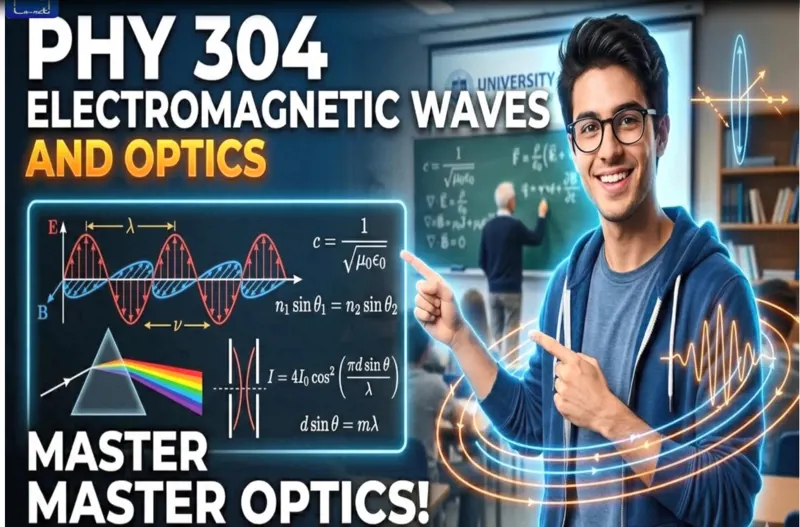
PHY 304 ELECTROMAGNETIC WAVES AND OPTICS is a 300 Level course in the Physics department, taught in the Second Semester. On La-Net Hub you can watch all 30 recorded lectures for free, grouped into 10 series, read the course lecture note online or download it as a PDF, and test yourself with practice questions.
Interference and diffraction are two fascinating phenomena that reveal the wave nature of light and other forms of electromagnetic radiation. Interference occurs when two or more waves overlap, leading to regions of constructive interference (where the waves reinforce each other) and destructive interference (where they cancel out). This produces striking patterns such as the alternating bright and dark fringes seen in the famous double-slit experiment. Diffraction, on the other hand, refers to the bending and spreading of waves when they encounter obstacles or pass through narrow openings. It explains why light can bend around edges and produce characteristic patterns of intensity. Together, interference and diffraction provide deep insights into the fundamental behavior of waves, forming the basis for technologies like diffraction gratings, holography, and even modern optical instruments. These phenomena not only demonstrate the elegance of wave physics but also underpin practical applications in science and engineering.
Electromagnetic waves and optics form a fundamental part of physics, bridging the study of light with the broader spectrum of electromagnetic radiation. Electromagnetic waves are oscillations of electric and magnetic fields that travel through space, carrying energy without the need for a physical medium. They encompass a wide range of phenomena, from radio waves and microwaves to visible light, ultraviolet rays, and X-rays. Optics, on the other hand, focuses specifically on the behavior and properties of light, including reflection, refraction, diffraction, and interference. Together, these topics provide the foundation for understanding how energy is transmitted across space, how light interacts with matter, and how technologies such as lenses, lasers, fiber optics, and imaging systems are developed. This introduction highlights the importance of electromagnetic waves and optics in both scientific exploration and practical applications, from communication systems to medical diagnostics.