Nigeria's free digital learning hub. Videos, lecture notes, practice questions and leaderboards aligned with CCMAS, NBTE, NCCE, WAEC, NECO, IJMB and JAMB curricula.
Loading
Nigeria's free digital learning hub. Videos, lecture notes, practice questions and leaderboards aligned with CCMAS, NBTE, NCCE, WAEC, NECO, IJMB and JAMB curricula.
Public Administration · 100 Level · Second Semester
KWASU-PAD 112 Descriptive Statistics is a 100 Level course in the Public Administration department, taught in the Second Semester. On La-Net Hub you can watch all 5 recorded lectures for free, grouped into 5 series, read the course lecture note online or download it as a PDF, and test yourself with practice questions.
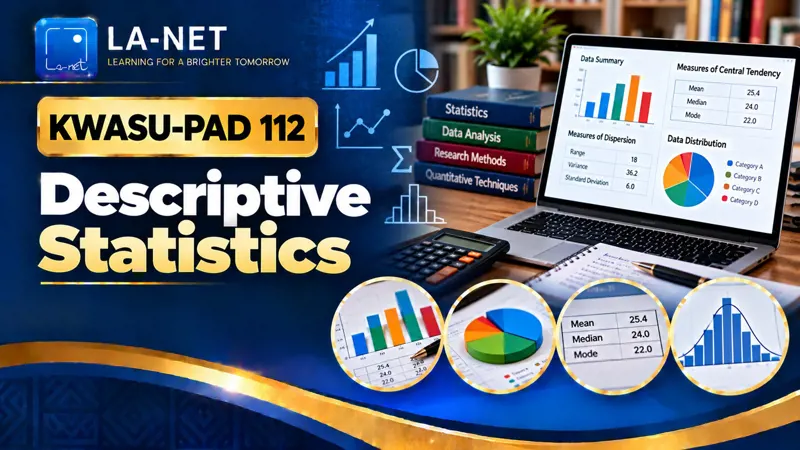
Foundations of Descriptive Statistics refers to the basic principles and methods used to organize, summarize, present, and interpret data in a meaningful way. It involves the use of statistical techniques such as tables, charts, graphs, measures of central tendency (mean, median, and mode), and measures of dispersion (range, variance, and standard deviation) to describe the main characteristics of a dataset. Descriptive statistics helps researchers, students, and decision-makers understand patterns, trends, and relationships within data without drawing conclusions beyond the information collected. These foundational concepts provide an essential basis for data analysis and support informed decision-making across various fields of study and professional practice.
Data Types and Sources refers to the classification of data based on its characteristics and the origins from which it is collected. Data types generally include qualitative data, which describes attributes or categories, and quantitative data, which represents numerical values that can be measured and analyzed. Data may also be categorized as primary data, collected directly through methods such as surveys, observations, experiments, and interviews, or secondary data, obtained from existing sources such as books, journals, government reports, databases, and online publications. Understanding different data types and sources is essential for selecting appropriate methods of data collection, analysis, and interpretation, thereby ensuring the accuracy, reliability, and relevance of research findings and decision-making processes.