Nigeria's free digital learning hub. Videos, lecture notes, practice questions and leaderboards aligned with CCMAS, NBTE, NCCE, WAEC, NECO, IJMB and JAMB curricula.
Loading
Nigeria's free digital learning hub. Videos, lecture notes, practice questions and leaderboards aligned with CCMAS, NBTE, NCCE, WAEC, NECO, IJMB and JAMB curricula.
Public Administration · 300 Level · Second Semester
KWASU-PAD 314 Theories of Decision Making is a 300 Level course in the Public Administration department, taught in the Second Semester. On La-Net Hub you can watch all 5 recorded lectures for free, grouped into 5 series, read the course lecture note online or download it as a PDF, and test yourself with practice questions.
Foundations of Decision Making refers to the fundamental principles, processes, and approaches involved in selecting the best course of action among available alternatives to achieve specific goals or solve problems. It involves identifying a problem or opportunity, gathering and analyzing relevant information, evaluating possible options, and choosing the most appropriate solution based on logical reasoning, evidence, values, and objectives. Effective decision making requires critical thinking, judgment, and the ability to assess risks, benefits, and consequences. Understanding the foundations of decision making enables individuals, organizations, and public institutions to make informed, rational, and objective choices that enhance performance, problem-solving, and goal achievement.
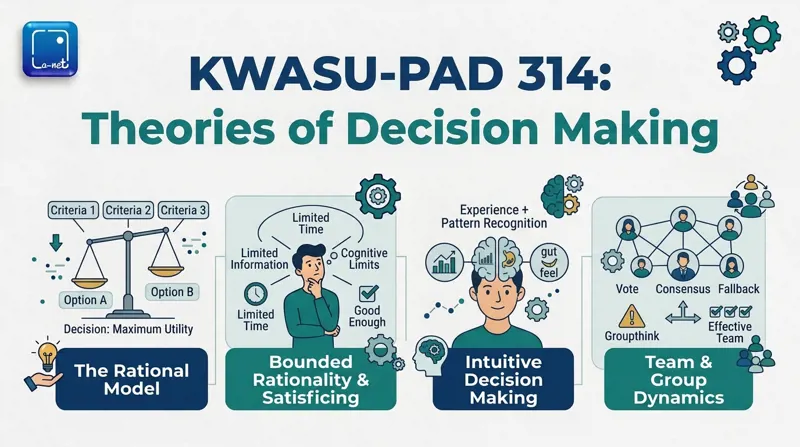
Classical and Contemporary Theories in decision making examine the evolution of ideas and approaches used to understand how individuals and organizations make choices. Classical theories emphasize rationality, assuming that decision-makers have complete information, evaluate all alternatives objectively, and select the option that maximizes benefits. In contrast, contemporary theories recognize the limitations of human reasoning, information constraints, uncertainty, and the influence of cognitive, social, and organizational factors on decision-making processes. These modern perspectives incorporate concepts such as bounded rationality, behavioral decision making, and evidence-based management. Understanding both classical and contemporary theories provides a comprehensive framework for analyzing decision-making behavior and improving the quality of decisions in personal, organizational, and public sector contexts.