Nigeria's free digital learning hub. Videos, lecture notes, practice questions and leaderboards aligned with CCMAS, NBTE, NCCE, WAEC, NECO, IJMB and JAMB curricula.
Loading
Nigeria's free digital learning hub. Videos, lecture notes, practice questions and leaderboards aligned with CCMAS, NBTE, NCCE, WAEC, NECO, IJMB and JAMB curricula.
Computer Science · 300 Level · Second Semester
CSC310 SYSTEM ANALYSIS AND DESIGN is a 300 Level course in the Computer Science department, taught in the Second Semester. On La-Net Hub you can watch all 28 recorded lectures for free, grouped into 10 series, read the course lecture note online or download it as a PDF, and test yourself with practice questions.
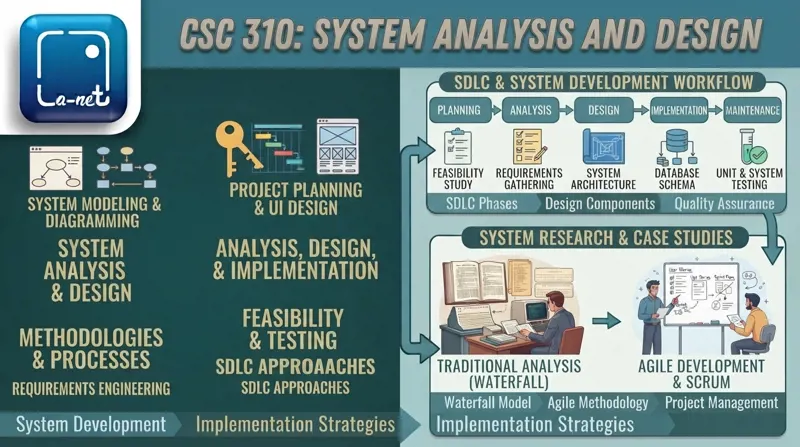
The foundation of systems analysis and design focuses on understanding how information systems are planned, developed, and managed to meet organizational needs effectively. It involves studying existing systems, identifying problems or opportunities for improvement, and designing solutions that integrate people, processes, and technology. Key concepts include requirements gathering, system modeling, feasibility analysis, and the application of structured or object-oriented methodologies. By following systematic approaches such as the system development life cycle (SDLC), analysts ensure that systems are efficient, reliable, and aligned with business goals, ultimately improving decision-making and organizational performance.
Interface design, project management, and case studies are interconnected elements that contribute to the successful development and delivery of products and systems. Interface design focuses on creating user-friendly, intuitive, and aesthetically pleasing interactions between users and digital or physical products, ensuring accessibility and efficiency. Project management involves planning, organizing, and coordinating resources, timelines, and teams to achieve specific objectives within set constraints such as time, scope, and budget. Case studies, on the other hand, provide real-world examples and detailed analyses of past projects, highlighting challenges, strategies, outcomes, and lessons learned. Together, these areas support innovation and informed decision-making by combining practical design principles, structured execution processes, and experiential knowledge from previous implementations.