Nigeria's free digital learning hub. Videos, lecture notes, practice questions and leaderboards aligned with CCMAS, NBTE, NCCE, WAEC, NECO, IJMB and JAMB curricula.
Loading
Nigeria's free digital learning hub. Videos, lecture notes, practice questions and leaderboards aligned with CCMAS, NBTE, NCCE, WAEC, NECO, IJMB and JAMB curricula.
Linguistics · 100 Level · Second Semester
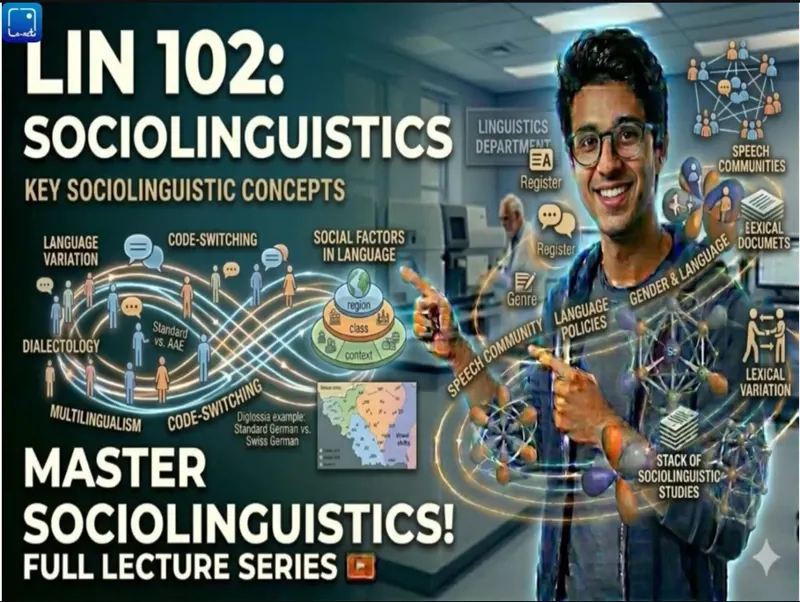
LIN 102 Sociolinguitics is a 100 Level course in the Linguistics department, taught in the Second Semester. On La-Net Hub you can watch all 20 recorded lectures for free, grouped into 7 series, read the course lecture note online or download it as a PDF, and test yourself with practice questions.
This series examines the close relationship between language and society, emphasizing how language functions as a social phenomenon and a means of communication within different cultural contexts. It explores the ways social factors such as age, gender, ethnicity, occupation, religion, education, and social class influence language use and variation. Students will study the role of language in shaping social identity, maintaining social relationships, and transmitting cultural values and beliefs. The course also introduces key concepts in sociolinguistics, including language variation, language change, multilingualism, language attitudes, and the impact of society on communication patterns. By the end of the series, learners will understand the dynamic interaction between language and social structures and appreciate the importance of language in human society.
This series explores how language shapes perception, constructs identity, and reflects ideological beliefs within society. It examines the ways individuals and groups use language to express personal, social, cultural, ethnic, religious, and national identities. Students will investigate how language influences thought, attitudes, and worldviews, as well as how power relations, social values, and political interests are embedded in linguistic practices. The course introduces concepts such as language and identity, language attitudes, stereotypes, discourse, representation, and language ideology. Through theoretical discussions and practical examples, learners will develop a deeper understanding of how language serves as a tool for self-expression, social inclusion, persuasion, and the reinforcement or challenge of societal beliefs and structures.