Nigeria's free digital learning hub. Videos, lecture notes, practice questions and leaderboards aligned with CCMAS, NBTE, NCCE, WAEC, NECO, IJMB and JAMB curricula.
Loading
Nigeria's free digital learning hub. Videos, lecture notes, practice questions and leaderboards aligned with CCMAS, NBTE, NCCE, WAEC, NECO, IJMB and JAMB curricula.
Business Administration · 200 Level · Second Semester
kwasu-pad216 Introduction to international relations is a 200 Level course in the Business Administration department, taught in the Second Semester. On La-Net Hub you can watch all 27 recorded lectures for free, grouped into 9 series, read the course lecture note online or download it as a PDF, and test yourself with practice questions.
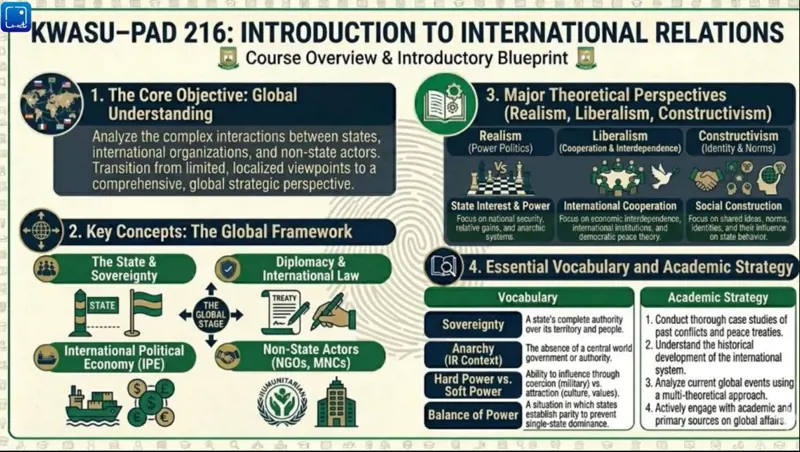
Actors in the international system are the key entities that participate in and influence global relations, including states (countries), international organizations like the United Nations, multinational corporations, and non‑governmental organizations. These actors interact through diplomacy, trade, and conflict to shape global politics and solve common problems. The system faces major issues such as war and security, economic inequality, environmental challenges, and human rights, which require cooperation among these actors. The course objective of this topic is to help learners understand the roles of different actors, analyze how they influence global affairs, and evaluate how international issues are managed within the global system.
Actors in the international system are the individuals and groups that influence global politics, mainly divided into state actors (sovereign countries with authority over territory and decision-making) and non-state actors such as international organizations, NGOs, and multinational corporations that operate beyond government control but still shape global outcomes. These actors interact to address key global issues including conflict and security, international trade, climate change, economic development, and humanitarian challenges, which often require cooperation across borders. The course objective is to help students understand the roles and interactions of these actors, analyze major global issues from multiple perspectives, and develop critical thinking skills to evaluate how global challenges are managed in an interconnected world.