Nigeria's free digital learning hub. Videos, lecture notes, practice questions and leaderboards aligned with CCMAS, NBTE, NCCE, WAEC, NECO, IJMB and JAMB curricula.
Loading
Nigeria's free digital learning hub. Videos, lecture notes, practice questions and leaderboards aligned with CCMAS, NBTE, NCCE, WAEC, NECO, IJMB and JAMB curricula.
Geophysics · 400 Level · Second Semester
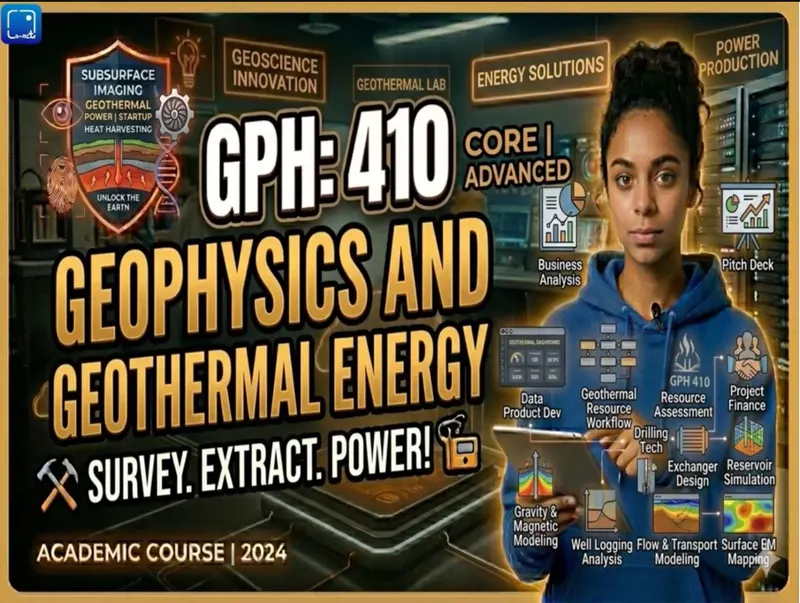
GPH 410 GEOPHYSICS AND GEOTHERMAL ENERGY is a 400 Level course in the Geophysics department, taught in the Second Semester. On La-Net Hub you can watch all 30 recorded lectures for free, grouped into 10 series, read the course lecture note online or download it as a PDF, and test yourself with practice questions.
Economic and geological factors play a decisive role in the development of geothermal energy projects. From an economic perspective, the feasibility of harnessing geothermal resources depends on the high upfront costs of exploration, drilling, and infrastructure, balanced against the long-term benefits of low operating expenses and stable energy supply. Regions with supportive policies, investment incentives, and access to financing are more likely to succeed in geothermal development. On the geological side, the availability of accessible geothermal reservoirs, high heat flow, and permeable rock formations are critical for efficient energy extraction. Areas located near tectonic plate boundaries, volcanic zones, or hot springs often provide the most favorable conditions. Together, these economic and geological considerations determine whether geothermal energy can be a viable, sustainable, and competitive source of power in a given region.
Geophysical methods are essential tools in both geothermal and hydrocarbon exploration, as they allow scientists to investigate subsurface structures without direct drilling. These techniques rely on measuring physical properties of the Earth, such as seismic waves, gravity, magnetism, and electrical conductivity, to infer the presence of heat reservoirs or hydrocarbon deposits. In geothermal exploration, methods like magnetotellurics and resistivity surveys help identify zones of high temperature and fluid content, while seismic imaging reveals fractures and permeability pathways crucial for energy extraction. For hydrocarbons, seismic reflection and refraction are widely used to map sedimentary layers and detect potential oil and gas traps. Gravity and magnetic surveys complement these approaches by highlighting variations in rock density and composition. Together, these geophysical methods provide a cost-effective and scientifically robust means of reducing exploration risks, guiding drilling operations, and maximizing resource recovery.