Nigeria's free digital learning hub. Videos, lecture notes, practice questions and leaderboards aligned with CCMAS, NBTE, NCCE, WAEC, NECO, IJMB and JAMB curricula.
Loading
Nigeria's free digital learning hub. Videos, lecture notes, practice questions and leaderboards aligned with CCMAS, NBTE, NCCE, WAEC, NECO, IJMB and JAMB curricula.
Geology · 400 Level · Second Semester
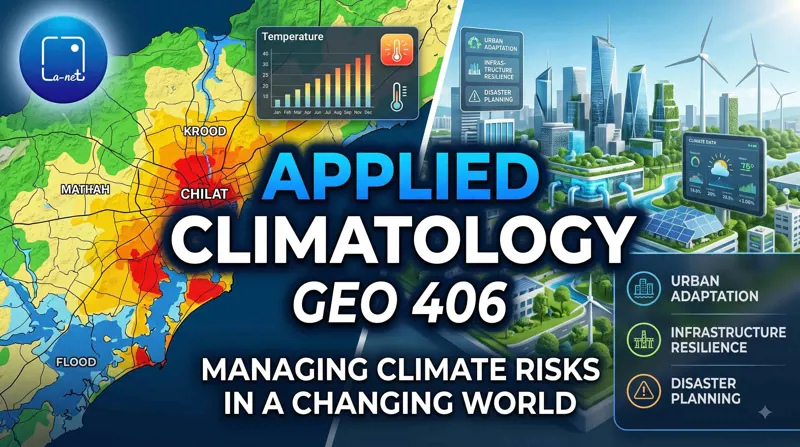
GEO 406 APPLIED CLIMATOLOGY is a 400 Level course in the Geology department, taught in the Second Semester. On La-Net Hub you can watch all 15 recorded lectures for free, grouped into 5 series, read the course lecture note online or download it as a PDF, and test yourself with practice questions.
Applied tropical climatology, particularly in agro- and bioclimatology, examines how tropical climate patterns directly influence agriculture, ecosystems, and human activities. Agroclimatology focuses on the relationship between climate and crop production, studying how factors like rainfall distribution, temperature, and solar radiation affect planting seasons, yields, and food security. Bioclimatology, on the other hand, explores how climate impacts living organisms more broadly, including vegetation, animal habitats, and human health. In tropical regions, where high temperatures and abundant rainfall dominate, these disciplines are essential for managing resources, predicting agricultural outcomes, and understanding ecological dynamics, ensuring sustainable development in climates that are both productive and vulnerable.
Climate change, human activities, and sustainable development in the tropics are deeply interconnected, as the region’s unique climate and ecosystems make it both highly productive and highly vulnerable. Human activities such as deforestation, urbanization, and intensive agriculture accelerate greenhouse gas emissions and disrupt natural cycles, leading to rising temperatures, shifting rainfall patterns, and more frequent extreme weather events. These changes threaten biodiversity, food security, and water resources, which are vital for millions of people living in tropical regions. Sustainable development in the tropics therefore requires balancing economic growth with environmental protection—through practices like renewable energy use, climate-smart agriculture, and conservation policies—to ensure resilience against climate change while safeguarding livelihoods and ecosystems for future generations.