

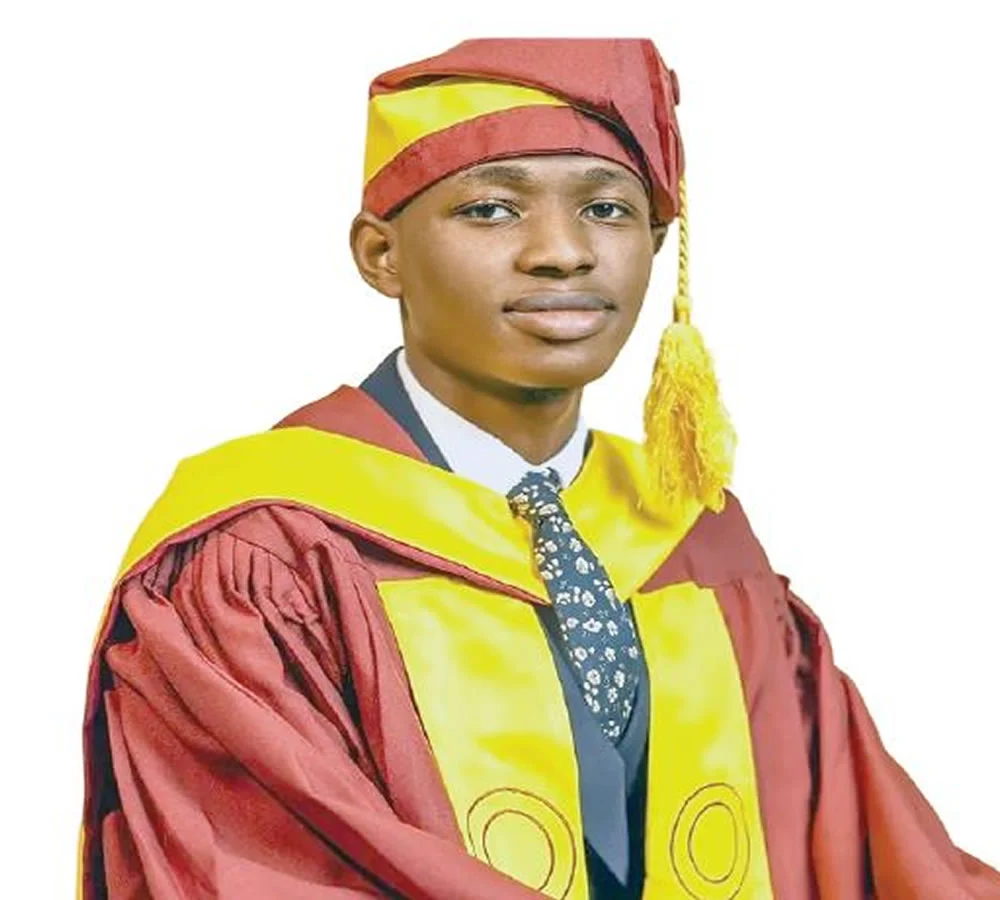
The Mechanical Mind and the AI Voice: How Saheed Azeez Conquered UNILAG and Taught Computers to Speak Nigerian
If you have ever spent a day on the campus of the University of Lagos, you know that the "Akoka vibe" is a unique mixture of intense pressure and high energy. It is a place where thousands of the brightest minds in the country are packed into lecture halls, all trying to prove they have what it takes to be the best. In such a competitive environment, graduating with a first class degree in Mechanical Engineering is a massive achievement on its own. But for Saheed Azeez, the degree was only half the story.
Saheed is the mind behind YarnGPT, an innovative artificial intelligence platform that can convert text into speech in Yoruba, Igbo, and Hausa. While his classmates were focused on surviving their final year projects, Saheed was busy teaching computers how to speak the languages of his ancestors. His journey is a perfect example of what happens when a student moves beyond just "reading for the certificate" and starts building for the future. It is a story of modest beginnings, strategic study habits, and a deep seated curiosity that began in the streets of Iju Ishaga.
The Iju Ishaga Foundation: Sacrifice and Resilience
Every success story has a starting point, and for Saheed, it began in Iju Ishaga, Lagos State. He did not come from a wealthy background where everything was handed to him on a silver platter. Instead, he grew up in a home where his father made a very specific kind of sacrifice. His father prioritized school fees above almost every other family expense. This created a sense of responsibility in Saheed from a very young age. He knew that his education was an investment, and he felt the weight of making that investment count.
Interestingly, Saheed was not always the "shining star" of every class. During his junior secondary school years, he actually struggled to stand out. He was bright, but he had not yet found his rhythm. It was only when he reached senior secondary school that something clicked. He made a conscious decision to stop waiting for teachers to spoon feed him information. He started studying independently, taking ownership of his own learning. This shift in mindset changed everything. By the time he was finishing secondary school, he was winning state wide chemistry competitions and serving as the Head Boy of his school.
The UNILAG Grind: Aiming for Perfection
When Saheed entered the University of Lagos to study Mechanical Engineering, he did not just want to pass. He set his sights on a perfect 5.0 CGPA. This might sound arrogant to some, but for him, it was about setting a standard that would keep him motivated. However, the university system has a way of humbling even the brightest students. In his very first semester, Saheed recorded a 4.21 CGPA.
For many students, a 4.21 is a dream result. But for Saheed, it was a wake up call. He realized that being smart was not enough; he had to learn how to "play the game" of the university system. He had to understand the psychology of his lecturers and the specific ways they wanted information presented in exams.
As he moved into his third year, which is notoriously the most difficult year for engineering students, he actually performed his best. He developed a deep interest in Thermodynamics, a subject that makes many students shiver. He also realized the power of community. He formed close bonds with his coursemates, and they supported one another through the most difficult topics. This is a vital lesson for any student: you do not have to be a lone wolf to be a first class student. Sometimes, the best way to learn is to teach others and be taught in return.
The Strategy: Why He Never Read at Night
One of the most practical and surprising parts of Saheed’s journey is his study habit. In a university culture where "TDB" (Till Day Break) is seen as a badge of honor, Saheed took a completely different path. He avoided reading at night. In fact, he generally stopped all academic work by 8 pm.
Instead of burning the midnight oil, Saheed "front loaded" his work. He started reading from the very first week of the semester. While other students were enjoying the "holiday" feel of the first few weeks, Saheed was already deep into his textbooks. By the time exams approached, he was not trying to learn new concepts; he was simply revising what he already knew.
He also emphasized the importance of "lecturer empathy." He understood that every lecturer is a human being with specific preferences. Some want you to give back their notes exactly as they gave them to you, while others want to see your own original thinking. Saheed made it his mission to understand these nuances, and it paid off in his grades.
The Birth of YarnGPT: Building for the Culture
While his academic performance was top tier, Saheed knew that a degree in Mechanical Engineering needed to be complemented by modern tech skills. In his second year, he began to dive into the world of Artificial Intelligence. He saw text to speech models being built for English, French, and German, and he asked a very important question: "What about us?"
He noticed that African languages were often neglected in the global AI race. He decided to build a platform that could handle the unique tones and nuances of Yoruba, Igbo, and Hausa. The opportunity to finish this project came during a strange period when his hostel was being renovated and classes were partially virtual. Instead of wasting that time, he spent two intense months at home building the first version of YarnGPT.
Saheed chose to release YarnGPT as an open source project. This is a very human and noble decision. He believes that for Nigerian tech to grow, we must build on each other’s work. By making his code available to everyone, he is allowing other developers to improve the system and create even more tools for our indigenous languages.
A Message for the Next Generation of Engineers
Despite his First Class degree and his AI breakthrough, Saheed remains incredibly humble. He does not see his graduation as a final destination but as a small step in a very long journey. He credited his father and his family for their public celebration of his success, but he is already looking at how he can solve bigger problems.
His advice to the Nigerian government and university administrators is very practical. He believes that engineering education in Nigeria is too focused on theory and not enough on practice. He is calling for more hands on training and better laboratory equipment. He believes that universities should form strong partnerships with technology companies so that students can work on real world problems while they are still in school.
Final Thoughts
Saheed Azeez is more than just a name on a first class list. He represents a new generation of Nigerian graduates who are not waiting for the government or a big corporation to give them a job. They are creating their own tools, solving their own cultural problems, and competing with the best in the world from their bedrooms and libraries.
Whether he is calculating the thermal efficiency of a machine or writing code for a Yoruba AI, Saheed’s journey teaches us that the key to success is a mixture of early sacrifice, strategic habits, and a heart that beats for your own culture. His story is a reminder to every student in UNILAG and across Nigeria that your background does not define your limit. If you start early, stay consistent, and look for ways to solve problems around you, the world will eventually have no choice but to listen to your voice, even if that voice is an AI speaking in your mother tongue.