

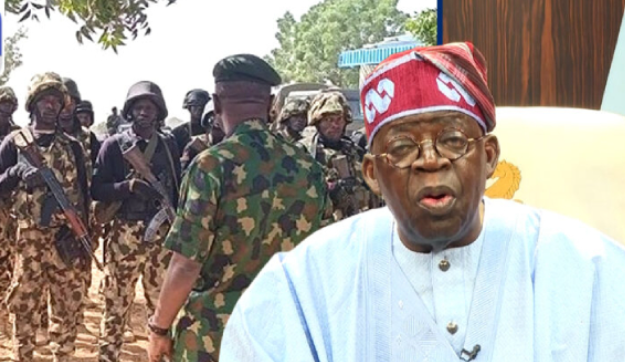
Tinubu Approves 12 Army Divisions, Recruitment of 28,000 Personnel to Boost Security
President Bola Ahmed Tinubu has approved the expansion of the Nigerian Army from eight to 12 divisions, in what the Federal Government says is part of a broader effort to strengthen Nigeria's security system and improve the military's ability to respond to threats across the country.
The approval comes as Nigeria continues to deal with a range of security challenges, including terrorism, banditry, kidnapping, communal conflicts and other forms of violent crime.
According to the Presidency, the expansion is part of a wider investment in the Armed Forces that also includes the recruitment of 28,000 additional military personnel, the acquisition of new equipment, improved welfare for troops and the ongoing modernisation of the military.
The announcement was contained in a statement issued by the President's Special Adviser on Information and Strategy, Bayo Onanuga.
The Presidency said the restructuring is designed to ensure that the Nigerian Army is better positioned to deal with the country's changing security environment.
Why the Army Is Being Expanded
The Nigerian Army's divisional structure is an important part of how military operations are organised across the country.
A division is a large military formation responsible for coordinating troops and operations within a particular area.
By increasing the number of divisions, the government expects to bring military command closer to areas where security threats occur.
The idea is that commanders operating closer to affected communities can respond more quickly and coordinate operations more effectively.
The Presidency said the new structure would improve command and control, decentralise decision-making and allow the Army to react faster when security situations develop.
For a country as large and geographically diverse as Nigeria, the ability to respond quickly can make a significant difference during emergencies.
Where the 12 Divisions Will Be Located
Under the new arrangement, the Nigerian Army will have 12 strategically positioned divisions across the country.
The existing formations will continue to operate, while four additional divisions will be established as part of the restructuring.
The approved structure is as follows:
1 Division, Kaduna: Responsible for Kaduna, Kano, Katsina and Jigawa States.
2 Division, Ibadan: Covering Oyo, Osun, Ekiti and Ondo States.
3 Division, Jos: Covering Plateau, Bauchi and Gombe States.
5 Division, Makurdi: Covering Benue, Nasarawa and Kogi States.
6 Division, Port Harcourt: Covering Rivers, Akwa Ibom and Cross River States.
7 Division, Maiduguri: Covering Borno and Yobe States.
8 Division, Sokoto: Covering Sokoto, Kebbi and Zamfara States.
9 Division, Ilorin: Covering Kwara and Niger States.
10 Division, Jalingo: Covering Taraba and Adamawa States.
81 Division, Lagos: Covering Lagos and Ogun States.
82 Division, Enugu: Covering Enugu, Anambra, Abia, Ebonyi and Imo States.
83 Division, Benin City: Covering Edo, Delta and Bayelsa States.
The locations mean that the Army will have additional divisional headquarters in areas that have experienced significant security and operational challenges.
New Divisions in Makurdi, Ilorin and Jalingo
Some of the most notable changes involve the creation of divisions in Makurdi, Ilorin and Jalingo.
The new 5 Division in Makurdi will cover Benue, Nasarawa and Kogi States.
This is particularly significant given the security challenges that have affected parts of the North Central region over the years.
The 9 Division in Ilorin will oversee Kwara and Niger States, while the 10 Division in Jalingo will cover Taraba and Adamawa.
The establishment of these formations is expected to strengthen military coordination and increase the presence of senior command structures in the affected regions.
The new 83 Division in Benin City will also cover Edo, Delta and Bayelsa States, providing another layer of command and coordination in the South-South.
What the Government Hopes to Achieve
The expansion is expected to have several benefits for Nigeria's security architecture.
One of the main objectives is faster response to security threats.
With military commands positioned closer to areas of operation, troops may be able to mobilise more quickly when communities come under attack or when intelligence points to an emerging threat.
The restructuring is also expected to improve border protection.
Nigeria shares borders with several countries, and securing these areas remains an important part of the country's national security strategy.
Another priority is the protection of critical national infrastructure.
Oil and gas facilities, power infrastructure, transportation networks and other strategic assets require security because disruptions can have consequences for the wider economy.
The Presidency also expects the expanded structure to strengthen counter-insurgency and internal security operations.
More Soldiers and Better Equipment
The expansion of the Army's structure is coming alongside plans to increase its personnel strength.
The Federal Government says it will recruit 28,000 additional personnel as part of its wider investment in national security.
For the new divisions to operate effectively, however, personnel numbers alone will not be enough.
The Presidency also highlighted plans to provide additional military equipment and improve the welfare of troops.
This is important because soldiers operating in difficult environments need reliable equipment, adequate logistics and proper welfare support.
Military operations can be demanding, particularly in areas affected by prolonged insecurity.
Better welfare could also help improve morale and support the retention of trained personnel.
Implementation Will Take Place in Two Phases
The restructuring will not happen all at once.
According to the Presidency, implementation will be carried out in two phases.
The first phase will involve the establishment of the 5, 9 and 10 Divisions, alongside the reorganisation of existing formations.
This phase is expected to be completed by September 2026.
The second phase will focus on establishing the 83 Division in Benin City and completing additional restructuring across the Army.
The government has set December 2026 as the target for completing the second phase.
The phased approach is expected to allow the Army to reorganise its command structures and personnel while continuing ongoing military operations.
What This Means for Nigerians
For ordinary Nigerians, the real test of the new structure will be whether it translates into safer communities.
The expansion itself is significant, but Nigerians will ultimately judge the policy by its results.
People want to see quicker responses to attacks, better protection for communities, safer roads and stronger security around schools, farms, businesses and critical infrastructure.
There is also an expectation that greater military presence will be accompanied by better coordination with the police, intelligence agencies and other security organisations.
Security challenges often cross geographical and institutional boundaries, meaning no single agency can effectively address them alone.
A Bigger Push to Modernise Nigeria's Military
The Army expansion forms part of President Tinubu's broader effort to strengthen Nigeria's defence capabilities.
The combination of new divisions, additional personnel, military equipment and improved welfare represents a substantial restructuring of the country's security architecture.
However, successful implementation will depend on effective planning, adequate funding and strong coordination.
Creating new headquarters is only the beginning. The new formations will need trained personnel, equipment, logistics, intelligence capabilities and clear operational responsibilities.
If those elements are properly provided, the restructuring could give the Nigerian Army a stronger presence across the country and improve its ability to respond to emerging threats.
For now, the government has set a clear timeline for the changes, with the first stage expected by September and the wider restructuring targeted for completion by December 2026.
The hope is that the expansion will ultimately bring military operations closer to the communities that need protection and help Nigeria build a faster, more coordinated and more responsive security system.