

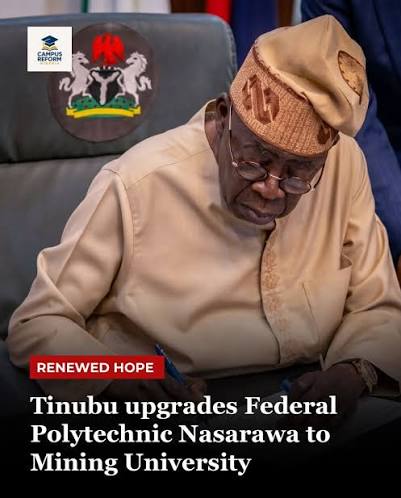
Federal Poly Nasarawa upgraded to a specialised university
For many years, the debate in Nigeria has been about the "Polytechnic vs. University" dichotomy. Students have often felt that a Higher National Diploma (HND) didn't carry the same weight as a Bachelor’s degree, despite the intense practical work involved in polytechnic education. Well, for the community of the Federal Polytechnic, Nasarawa, that debate just took a back seat to a much bigger story.
President Bola Ahmed Tinubu recently gave the green light for a massive transformation: the Federal Polytechnic, Nasarawa, is officially being upgraded to the Federal University of Mining, Engineering and Technology (FUMET), Nasarawa.
This isn't just a fancy name change or a way to give the institution a "status boost." If you look closely at the timing and the focus of this new university, you’ll see it’s a strategic move to solve a major Nigerian problem. Let’s break down what this actually means for students, the economy, and the future of technical education in Nigeria.
Why Nasarawa? Why Mining?
If you’ve ever traveled through Nasarawa State, you know it isn’t called the "Home of Solid Minerals" for fun. The state is sitting on a literal goldmine (and lithium-mine, and tin-mine). For decades, Nigeria has been "the oil country," but as the world shifts toward green energy and electric vehicles, minerals like lithium have become the "new oil."
The problem? We have the minerals in the ground, but we often lack the home-grown technical expertise to extract and process them efficiently. Most of the high-level engineering work in our mining sector is done by foreign firms. By establishing a specialized University of Mining, Engineering, and Technology right in the heart of a mineral-rich state, the government is essentially saying: "We want to train our own experts to manage our own wealth."
Beyond the Name: What Changes for the Students?
If you are a current student at Fed Poly Nasarawa, or a candidate thinking about applying, you probably have a hundred questions. “Does my HND become a B.Sc.?” “Will the school be more expensive?” “Will the lecturers change?”
While an upgrade like this takes time to fully implement, the long-term benefits are huge.
- Specialization is King: In the modern job market, being a "General Engineer" is okay, but being a "Mining Engineer" or a "Mineral Processing Specialist" makes you a hot cake. This university will offer niche courses that you won't find in a standard regular university.
- Research Opportunities: Universities have a much stronger focus on research and development (R&D) than polytechnics. This means students will be encouraged to find new ways to solve local mining challenges, potentially leading to patents, startups, and innovation hubs.
- Degree Parity: The upgrade solves the old "HND vs. B.Sc." headache. Graduates will leave with degrees that are internationally recognized in the specialized fields of technology and engineering.
The "Practical" Reality: We Need Labs, Not Just Letters
Let’s have some "real talk." Upgrading a school isn't just about changing the signpost at the front gate. To be a world-class University of Mining and Technology, FUMET needs more than just a new name; it needs infrastructure.
Mining and engineering education is incredibly expensive. We’re talking about high-end geology labs, mineral processing plants, advanced CAD/CAM software for engineering design, and partnerships with actual mining sites. If the government provides the funding to kit out these labs, Nasarawa could become the "MIT of Nigeria" for the mining sector. If they don’t, it remains a polytechnic in everything but name.
As a student, this is what you should be watching. Look for the arrival of new equipment and the recruitment of specialized professors. That is when the "upgrade" truly begins.
Career Paths You Might Not Have Considered
When we think of "Technical Education," many people just think of fixing machines or working on a construction site. But look at what a specialized university like this offers:
- Environmental Remediation: Mining can be messy. We need experts to ensure that when we take minerals out of the ground, we don't destroy the farmland or poison the water for the local community.
- Mineral Economics: Someone has to understand the global market for these resources.
- Geographical Information Systems (GIS): Using satellites and data to map out where the minerals are without digging up the whole state.
- Tech Integration: Developing the software and AI that controls modern mining equipment.
These are high-paying, high-impact careers that this new university can help you launch.
Bridging the Gap: Education Meets Industry
For too long, Nigerian universities have operated in a "bubble," teaching theories that don't always apply to the real world. FUMET has a unique opportunity to break that cycle.
Imagine a situation where students spend their 300-level year doing intensive internships with mining companies right there in Nasarawa or nearby Kogi and Jos. Imagine industry experts from mining firms coming into the lecture halls to teach the practical side of the business. This "town and gown" relationship is what makes specialized universities in countries like Australia and Canada so successful. It’s what we need here.
A Word of Advice for Prospective Students
Technical education is not a "walk in the park." Engineering and technology courses are rigorous. They require a very strong foundation in Mathematics and Physics. If you are eyeing a spot in this new university, you can’t afford to be "average" in your sciences.
This is where your study habits come in. You can't start reading a week before the exam and expect to master mineralogy or structural engineering. You need a system. This is where platforms like La-Net Hub come into play helping you revisit those tough science concepts, practicing complex questions, and building the mental discipline you’ll need to survive a high-level engineering curriculum.
The Big Picture: Diversifying the Nigerian Economy
President Tinubu’s approval of this upgrade is a piece of a much larger puzzle. Nigeria is trying to move away from being a "mono-product economy" (oil). By investing in mining and technology education, the government is betting on the fact that our future lies in what we can build and what we can extract from our soil not just what we can pump out of the creeks.
For the people of Nasarawa, this is a moment of pride. It brings development, it brings jobs, and it puts the state on the global map of technical education.
Wrapping Up
The transformation of Federal Polytechnic, Nasarawa into the Federal University of Mining, Engineering and Technology is a bold move. It’s a practical response to the needs of the 21st-century Nigerian economy.
However, the success of this transition depends on more than just a presidential signature. It depends on consistent funding, visionary leadership from the new university's management, and, most importantly, the hunger of the students to become the best in their fields.
If you’re a student in Nasarawa or planning to head there, you are standing at the edge of a new frontier. The "Home of Solid Minerals" is about to become the "Home of Technical Brains." Get ready it’s going to be an exciting ride.