

Education Minister Highlights Progress in Nigeria’s Learning Reforms
The Federal Government has highlighted a number of reforms introduced in Nigeria’s education sector under President Bola Tinubu, with the Minister of Education, Dr Tunji Alausa, saying the changes are designed to improve learning outcomes and create lasting benefits for future generations.
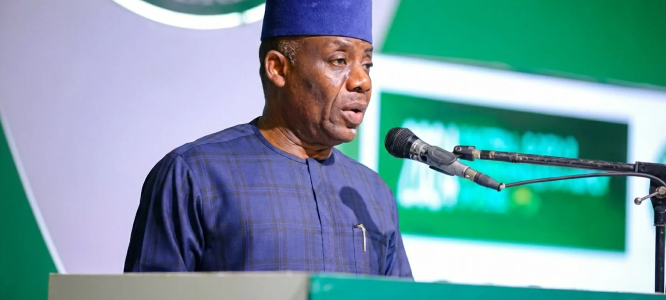
Alausa made this known during a special session at the Education World Forum, EWF, in London, United Kingdom, where he joined education ministers and other international stakeholders to discuss Nigeria’s efforts to strengthen foundational learning.
The minister used the session to outline some of the steps being taken by the Federal Government to address challenges in basic education, particularly in literacy and numeracy.
According to him, the government is moving towards a more coordinated approach to foundational learning, with interventions targeting children in both formal schools and non-formal learning environments.
Government Focuses on Literacy and Numeracy
One of the major areas highlighted by Alausa was the Federal Government’s effort to improve children's ability to read, write and perform basic mathematical operations.
He explained that Nigeria has introduced a unified approach to foundational literacy and numeracy, with the aim of ensuring that children acquire essential learning skills during their early years of education.
The focus is important because children who struggle with basic reading and numeracy often face difficulties as they progress through school. When pupils do not develop these skills early enough, it can affect their ability to understand more advanced subjects later in their education.
The Federal Government is therefore working to strengthen the foundation on which pupils build their future academic knowledge.
Among the initiatives being expanded are the RANA programme for pupils in Primary 1 to Primary 3 and Teaching at the Right Level, which targets learners in Primary 4 to Primary 6.
The programmes are being expanded through the Universal Basic Education Commission, UBEC, across 15 states.
More Support for Teachers
A key feature of the interventions is the emphasis on supporting teachers rather than simply providing learning materials to pupils.
According to the minister, the programmes use structured teaching materials, continuous teacher support and regular assessments to help teachers understand what their pupils know and where they need additional assistance.
This approach is particularly important in classrooms where pupils may have different levels of understanding despite being in the same class.
Rather than expecting every child to learn at exactly the same pace, teaching strategies can be adjusted based on the actual learning levels of pupils.
Regular assessments also allow teachers and education managers to identify areas where students are struggling and respond before the learning gaps become more difficult to address.
Reaching Children Outside the School System
Alausa also drew attention to the Accelerated Basic Education Programme, ABEP, developed by the Nigerian Educational Research and Development Council.
The programme is designed to provide literacy and numeracy opportunities to children and young people who are outside the formal education system.
This is particularly significant for Nigeria, which continues to face challenges associated with out-of-school children.
For children who have missed years of formal schooling, returning to a conventional classroom may not always be straightforward. Programmes such as ABEP can provide alternative pathways through which learners can acquire basic educational skills and eventually progress in their education.
The minister's comments suggest that the government's approach is not limited to improving existing schools. It also seeks to reach children who have been left outside the formal education system.
States Are Testing New Approaches
Beyond federal programmes, Alausa highlighted several state-level education initiatives that have adopted technology, data and structured teaching approaches.
He mentioned EKOEXCEL in Lagos State, KwaraLEARN in Kwara State and BayelsaPRIME in Bayelsa State as examples of interventions that have recorded measurable improvements.
These programmes have attracted attention because they attempt to address education challenges using data to understand what is happening in classrooms and determine where additional support is needed.
According to Alausa, KwaraLEARN significantly reduced foundational learning challenges within two years of implementation.
He also pointed to improvements recorded through BayelsaPRIME, saying the programme produced notable gains in literacy performance within weeks of being introduced.
While education interventions often take years before their full impact can be measured, the government believes that these early results demonstrate the potential of using data and technology to improve classroom learning.
Why Foundational Learning Matters
For many children, the first few years of primary school determine how successfully they will progress through the rest of their education.
A child who cannot read confidently or understand basic mathematics may find it difficult to keep up when lessons become more complicated.
This is why foundational learning has become an increasingly important part of education policy discussions in Nigeria.
Improving literacy and numeracy is also connected to wider social and economic development. A population with stronger basic educational skills is better positioned to acquire technical skills, pursue further education and participate meaningfully in the economy.
For Nigeria, strengthening these skills at an early stage could therefore have benefits that extend beyond the classroom.
Government Plans National Policy on Foundational Learning
Alausa said the Federal Government is working on a National Policy on Foundational Literacy and Numeracy.
The proposed policy is expected to provide a long-term framework for coordinating foundational learning programmes across federal and state education systems, as well as non-formal learning environments.
The minister explained that the policy would help strengthen coordination, funding and implementation of literacy and numeracy initiatives across the country.
The need for a national framework is particularly important because education delivery in Nigeria involves different levels of government.
While the Federal Government provides national policies and support, state governments play major roles in managing schools and implementing education programmes. Without effective coordination, different programmes can sometimes operate separately, making it difficult to achieve consistent results.
A national policy could provide a clearer direction while allowing states to adapt programmes to their specific circumstances.
The Bigger Picture for Nigerian Education
The reforms highlighted by Alausa reflect the Federal Government's broader education agenda under the Renewed Hope administration.
However, the success of these initiatives will ultimately depend on implementation.
Providing policies and programmes is only one part of improving education. Teachers need the right training and support, schools require adequate facilities, learning materials must reach pupils, and education authorities need reliable data to track progress.
There is also the question of sustainability. Programmes that produce positive results must receive consistent funding and monitoring if those gains are to be maintained over time.
For students and parents, the real measure of these reforms will be what happens inside classrooms. If more children are able to read confidently, understand basic mathematics and develop the skills needed to progress through school, then the impact of the reforms will become much easier to see.
Alausa's presentation at the Education World Forum placed Nigeria's foundational learning challenge within a wider international conversation about the future of education.
The message from the Federal Government is clear: improving the quality of basic education is not simply about changing what happens in schools today. It is about building a stronger foundation for the country's future workforce and ensuring that children have the skills they need to succeed.
If the current reforms are properly implemented, coordinated and sustained, they could play an important role in addressing some of Nigeria's longstanding education challenges and improving learning opportunities for millions of children across the country.