Nigeria's free digital learning hub. Videos, lecture notes, practice questions and leaderboards aligned with CCMAS, NBTE, NCCE, WAEC, NECO, IJMB and JAMB curricula.
Loading
Nigeria's free digital learning hub. Videos, lecture notes, practice questions and leaderboards aligned with CCMAS, NBTE, NCCE, WAEC, NECO, IJMB and JAMB curricula.
Cyber Security · 200 Level · Second Semester
CYB204 Applied mathematics in cyber is a 200 Level course in the Cyber Security department, taught in the Second Semester. On La-Net Hub you can watch all 15 recorded lectures for free, grouped into 5 series, read the course lecture note online or download it as a PDF, and test yourself with practice questions.
Discrete Mathematics for security modeling focuses on the use of mathematical structures such as logic, sets, graphs, combinatorics, and number theory to design, analyze, and verify secure systems. It provides the foundational tools for representing complex security mechanisms like cryptographic algorithms, authentication protocols, access control systems, and network security models in a precise and formal way. By applying discrete structures, security experts can reason about potential vulnerabilities, model threat scenarios, and prove the correctness and strength of security solutions. This area is essential in cybersecurity because it enables the systematic analysis of risks and ensures that security systems are robust, reliable, and resistant to attacks.
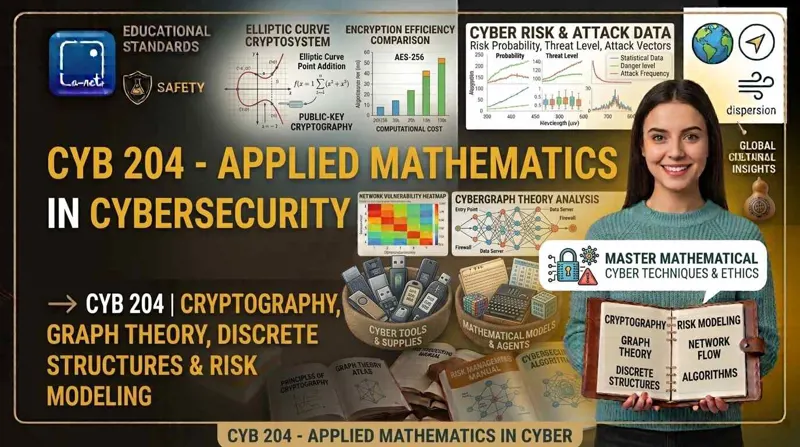
Introduction to applied mathematics in cybersecurity focuses on how mathematical concepts and techniques are used to design, analyze, and strengthen systems that protect digital information. It combines areas such as algebra, number theory, probability, statistics, and discrete mathematics to address real-world security challenges, including encryption, data integrity, authentication, and network defense. For example, cryptography relies heavily on number theory and algorithms to secure communication, while probability and statistics help detect anomalies and potential cyber threats in large datasets. By applying mathematical models and problem-solving methods, cybersecurity professionals can create stronger security protocols, evaluate risks, and develop efficient solutions to protect against evolving cyber attacks.