Nigeria's free digital learning hub. Videos, lecture notes, practice questions and leaderboards aligned with CCMAS, NBTE, NCCE, WAEC, NECO, IJMB and JAMB curricula.
Loading
Nigeria's free digital learning hub. Videos, lecture notes, practice questions and leaderboards aligned with CCMAS, NBTE, NCCE, WAEC, NECO, IJMB and JAMB curricula.
AEROSPACE ENGINEERING · 200 Level · Second Semester
AAE 204 AIRCRAFT FLIGHT PRINCIPLE/FLIGHT MECHANICS is a 200 Level course in the AEROSPACE ENGINEERING department, taught in the Second Semester. On La-Net Hub you can watch all 27 recorded lectures for free, grouped into 9 series, read the course lecture note online or download it as a PDF, and test yourself with practice questions.
Aeroelasticity is the study of how aerodynamic forces interact with the elastic properties of an aircraft’s structure, and it plays a critical role in flight safety and performance. The elastic axis is a reference line along the wing or structure where bending and twisting motions are balanced, serving as a key factor in determining how loads are distributed. Divergence occurs when aerodynamic forces acting on a flexible wing exceed its structural stiffness, causing uncontrollable twisting that can lead to structural failure. Flutter , one of the most dangerous aeroelastic phenomena, is a self-excited oscillation resulting from the interaction of aerodynamic forces, structural elasticity, and inertial effects; if not controlled, it can rapidly grow and destroy the aircraft. Understanding these principles allows engineers to design structures that resist instability, ensuring both efficiency and safety in modern aviation.
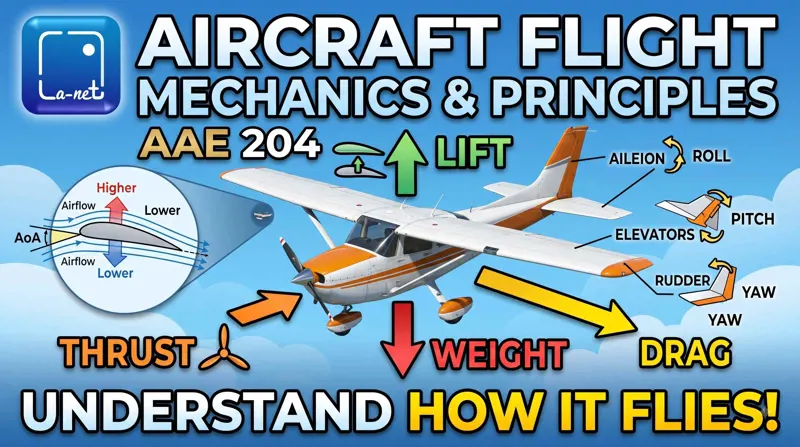
Aircraft stability and control principles are fundamental to ensuring safe and predictable flight. Stability refers to the aircraft’s natural tendency to return to its original flight condition after a disturbance, which can be classified as static (initial response) or dynamic (long-term behavior). Control, on the other hand, involves the pilot’s ability to deliberately change the aircraft’s attitude and trajectory using control surfaces such as the ailerons, elevators, and rudder. These principles are closely linked to the aircraft’s design, including its center of gravity, aerodynamic layout, and structural configuration. Together, stability and control ensure that an aircraft can resist unwanted motions while still being maneuverable enough to perform desired operations, striking a balance between safety and responsiveness in flight.